
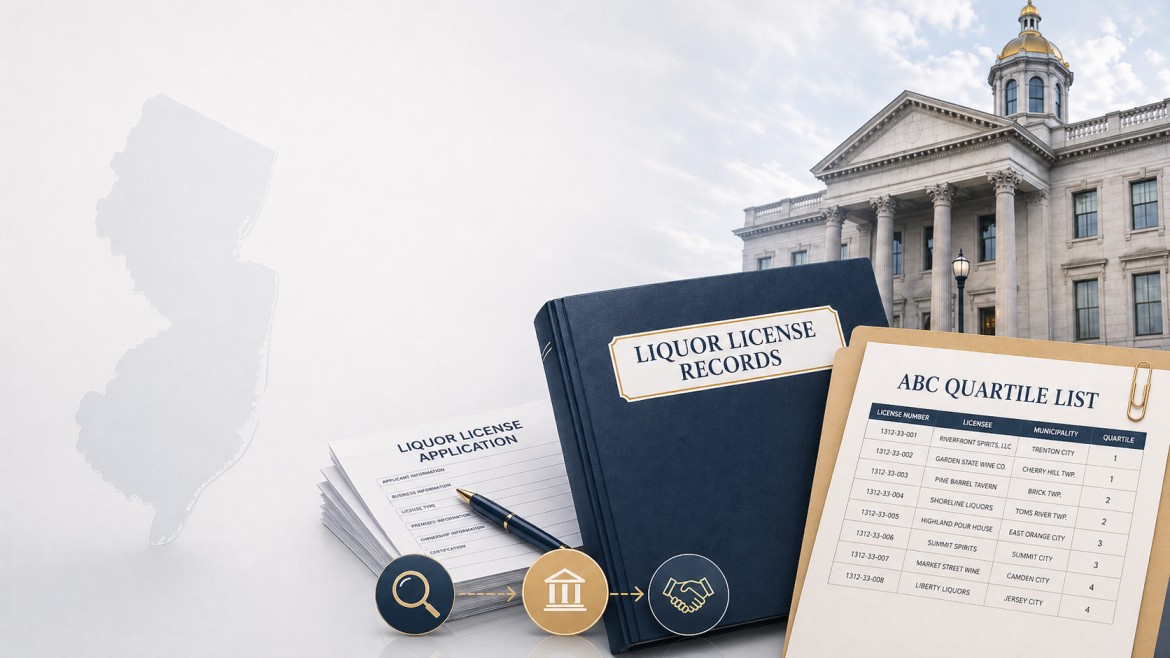
New Jersey’s 2024 liquor license reform created a major change for municipalities, clerks, administrators, mayors, and license holders across the state.
For years, many New Jersey plenary retail consumption licenses sat inactive, sometimes referred to as “pocket licenses.” These licenses often had value, but they were not being used by an operating restaurant, bar, or hospitality business.
That changed with the passage of S4265/A5912, which was signed into law in January 2024. The new law created rules designed to move inactive licenses back into productive use, either through activation, private sale, municipal transfer, or public sale in certain situations. The New Jersey Business Action Center also summarized the change as a “use it or lose it” update for inactive liquor licenses beginning August 1, 2024.
For municipal clerks and local officials, this is more than a liquor license issue. It is an economic development issue.
Why Municipal Clerks Should Pay Attention
Municipal clerks are often the first point of contact for liquor license questions. Business owners, attorneys, license holders, buyers, and local officials may contact the clerk’s office to ask about availability, renewals, inactive status, transfers, public notices, council approvals, and local procedures.
The new law matters because inactive licenses may no longer be allowed to sit unused indefinitely. Under the legislation, an inactive license generally refers to a plenary retail consumption license that has been placed on inactive status and renewed for two consecutive license terms.
That means municipalities should have a clear understanding of:
- Which licenses are inactive
- How long each license has been inactive
- Whether any license appears on the ABC Quartile List
- Whether the license holder may be looking to activate, sell, or transfer the license
- Whether the municipality has economic development opportunities tied to restaurant, bar, hotel, downtown, shopping center, or redevelopment projects
What Changed Under the 2024 NJ Liquor License Law?
The biggest change is that inactive licenses now face more pressure to move.
Before an inactive license expires, the law identifies several potential paths. A license may be actively used by the license holder, transferred in a private transaction for fair market value to someone who intends to use it, or transferred from a sending municipality to a receiving municipality under the new municipal transfer process.
The legislation also allows certain contiguous municipal transfers. A receiving municipality that has reached its population limitation may request proposals to acquire an inactive plenary retail consumption license from a contiguous sending municipality for use as part of an economic redevelopment plan or in a redevelopment, improvement, or revitalization area.
For local officials, the practical takeaway is simple:
Inactive licenses may now become opportunities for business attraction, downtown revitalization, restaurant recruitment, and local redevelopment planning.
What Is the NJ ABC Quartile List?
The NJ ABC Quartile List is the state’s list of inactive liquor licenses organized by the length of time they have been inactive.
The law directs the Director of the Division of Alcoholic Beverage Control to divide inactive plenary retail consumption licenses into quartiles based on the total length of inactivity. The longest-inactive group is addressed first, followed by the next groups over the following years.
The New Jersey Division of ABC’s Quartile List as of January 6, 2026 includes inactive license records going back decades. The list is organized into sections including:
- Quartile 1: 1993–1994 to 2000–2001
- Quartile 2: 2001–2002 to 2008–2009
- Quartile 3: 2009–2010 to 2016–2017
- Quartile 4: 2017–2018 to 2023–2024
- Licenses that went inactive after August 1, 2024
Based on Liquor License HQ’s review of the January 6, 2026 Quartile List, the file includes 1,184 inactive license records statewide. The counties with the highest number of listed inactive licenses include:
| County | Inactive License Records |
|---|---|
| Hudson County | 119 |
| Essex County | 114 |
| Middlesex County | 110 |
| Bergen County | 109 |
| Passaic County | 85 |
| Monmouth County | 81 |
| Union County | 74 |
| Atlantic County | 72 |
| Morris County | 62 |
| Camden County | 55 |
Several municipalities also appear repeatedly on the list, including Newark, Jersey City, Elizabeth, Paterson, Atlantic City, New Brunswick, Bayonne, Trenton, Hamilton Township, Hoboken, Egg Harbor Township, West Orange, Clifton, Camden, and Woodbridge.
What Should Municipal Clerks and Administrators Review?
Municipal clerks and administrators may want to review the Quartile List with the municipal attorney, governing body, ABC officials, and economic development team.
A simple municipal review can include:
- Identifying all inactive licenses tied to the municipality
- Confirming the current license holder and renewal status
- Reviewing how long the license has been inactive
- Determining whether the license is in Quartile 1, 2, 3, or 4
- Reviewing whether any license could support local redevelopment or downtown business goals
- Understanding whether a private buyer, seller, attorney, or neighboring municipality has expressed interest
- Preparing for public questions from business owners, restaurant operators, developers, or residents
This does not mean every inactive license will be sold, transferred, or reactivated immediately. It does mean municipalities should know what is on the list and understand the potential local impact.
Why This Matters for Economic Development
In many New Jersey towns, liquor license scarcity has limited restaurant and hospitality growth. A full-service restaurant, hotel project, entertainment concept, or downtown redevelopment plan may be harder to finance or operate without the right liquor license.
Inactive licenses can represent untapped local value.
When an inactive license is brought back into use, the municipality may benefit from:
- New restaurant or bar investment
- Increased downtown foot traffic
- More attractive redevelopment projects
- New jobs
- Stronger commercial corridors
- Better use of existing license inventory
- Potential license transfer activity
For mayors and administrators, the Quartile List is not just a compliance document. It can also be a roadmap for identifying dormant assets that may support local business growth.
How Liquor License HQ Can Help
Liquor License HQ helps New Jersey license holders, buyers, municipalities, attorneys, and business owners better understand the liquor license marketplace.
For municipal clerks and administrators, we can help with:
- Reviewing inactive license opportunities
- Identifying buyer or seller interest
- Helping license holders understand market value
- Coordinating with attorneys and transfer professionals
- Supporting business owners looking for available licenses
- Explaining how inactive licenses may fit into broader economic development goals
Liquor License HQ does not replace municipal counsel or the Division of ABC. Instead, we help connect the practical marketplace side of liquor license transactions with the legal and municipal process.
Questions About an Inactive NJ Liquor License?
If your municipality, business, or client has questions about an inactive New Jersey liquor license, the Quartile List, or potential buyer and seller interest, Liquor License HQ can help you understand the next step.
Contact Liquor License HQ to discuss inactive liquor license opportunities in New Jersey.